


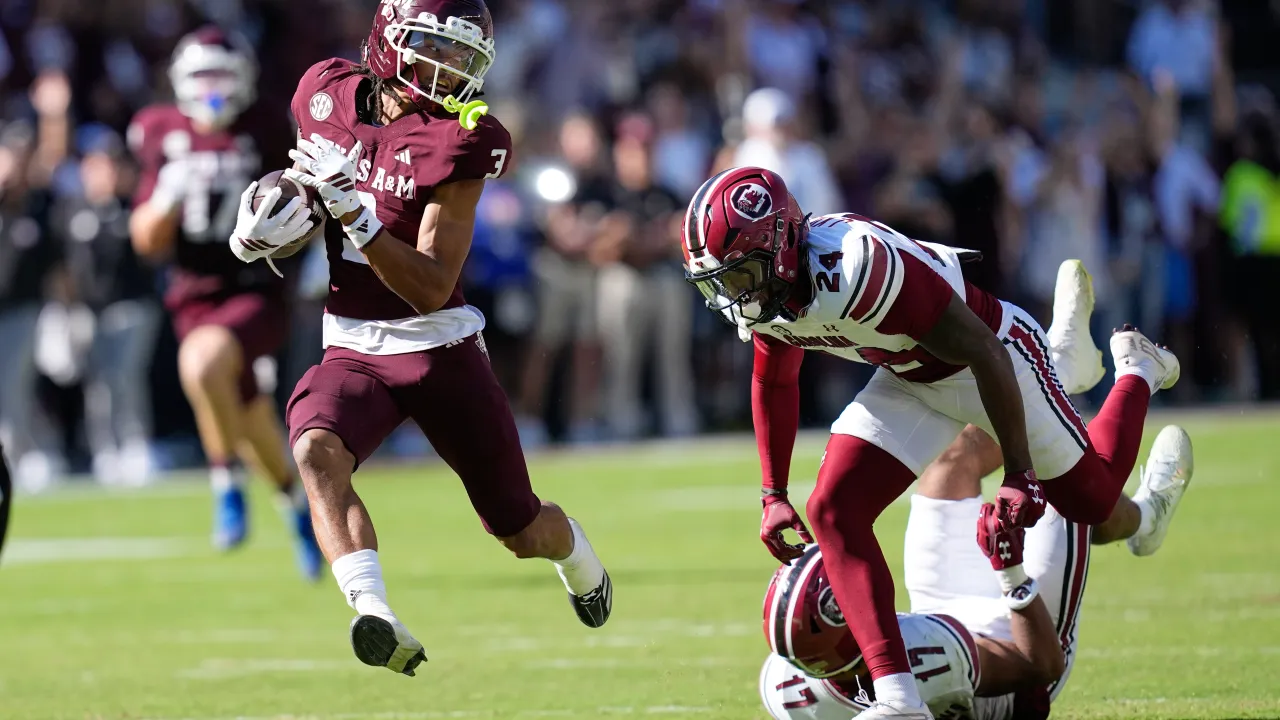
Texas A&M staged a historic comeback to beat South Carolina 31‑30, overturning a 27-point halftime deficit. The victory dramatically improves their playoff prospects and marks one of the most remarkable turnarounds in recent college football history. Fans and analysts are praising the team’s resilience, focus, and ability to execute under extreme pressure.
South Carolina dominated the first half, building a commanding lead through efficient offense and strong defensive stops. Texas A&M struggled to move the ball and failed to convert key opportunities, allowing South Carolina to establish a 27-point advantage by halftime. At that point, few expected the Aggies to recover, making the second-half performance even more impressive.
The comeback began with a shift in momentum during the third quarter. Texas A&M’s defense tightened, forcing crucial stops and creating turnover opportunities. These defensive plays provided the offense with better field position, enabling quicker scoring drives. Aggressive adjustments by the coaching staff, including changes in play calling and personnel, helped the team exploit weaknesses in South Carolina’s strategy.
Offensively, Texas A&M executed high-efficiency drives, combining short passes and dynamic runs to chip away at the lead. Quarterback leadership and clutch plays were key to the turnaround, as precision passes and timely runs kept drives alive. The team scored multiple unanswered touchdowns, turning what had been a seemingly insurmountable deficit into a one-point lead.
Special teams also played a critical role in the comeback. Accurate field goals, effective kick coverage, and key returns helped sustain momentum. Each point and successful conversion mattered in a game that remained tightly contested until the final whistle. The Aggies’ ability to execute in all three phases—offense, defense, and special teams—was essential to completing the historic comeback.
The final moments of the game were filled with tension. South Carolina had opportunities to reclaim the lead, but Texas A&M’s defense made decisive plays, including critical tackles and a goal-line stop that preserved the one-point advantage. The team then managed the clock carefully, securing the 31‑30 victory and leaving the crowd in awe of the remarkable turnaround.
This comeback boosts Texas A&M’s playoff hopes significantly. Overcoming a 27-point halftime deficit demonstrates mental toughness and the ability to perform under pressure, qualities highly valued in postseason evaluations. The win also sends a strong message to other top programs that the Aggies are capable of competing at the highest level, even in challenging circumstances.
For South Carolina, the loss is a difficult setback. Building such a large halftime lead only to see it erased highlights the importance of maintaining focus and adapting to in-game adjustments. Coaches and players will likely review the second-half performance to understand how the momentum shifted and what can be done to prevent similar outcomes in future games.
Fans of Texas A&M celebrated the historic victory as one of the most exciting moments of the season. The comeback demonstrates the importance of resilience, teamwork, and belief in the ability to overcome challenges. Players and coaches alike credited preparation, adjustments, and determination as the key factors that made the turnaround possible.
Analysts note that comebacks of this magnitude are rare in college football, emphasizing the difficulty of overcoming a 27-point halftime deficit. Texas A&M’s performance will be studied as an example of how strategic changes, relentless effort, and composure under pressure can change the course of a game.
In summary, Texas A&M completed a historic comeback to beat South Carolina 31‑30, overcoming a 27-point halftime deficit. The victory strengthens playoff prospects and highlights the team’s resilience, execution, and determination. This remarkable turnaround will be remembered as a defining moment of the season and a testament to the Aggies’ ability to perform in high-pressure situations.
